The more difficult question is what allows sovereignty to endure not merely as an assertion of authority, but as a political relationship in which citizens can see themselves.
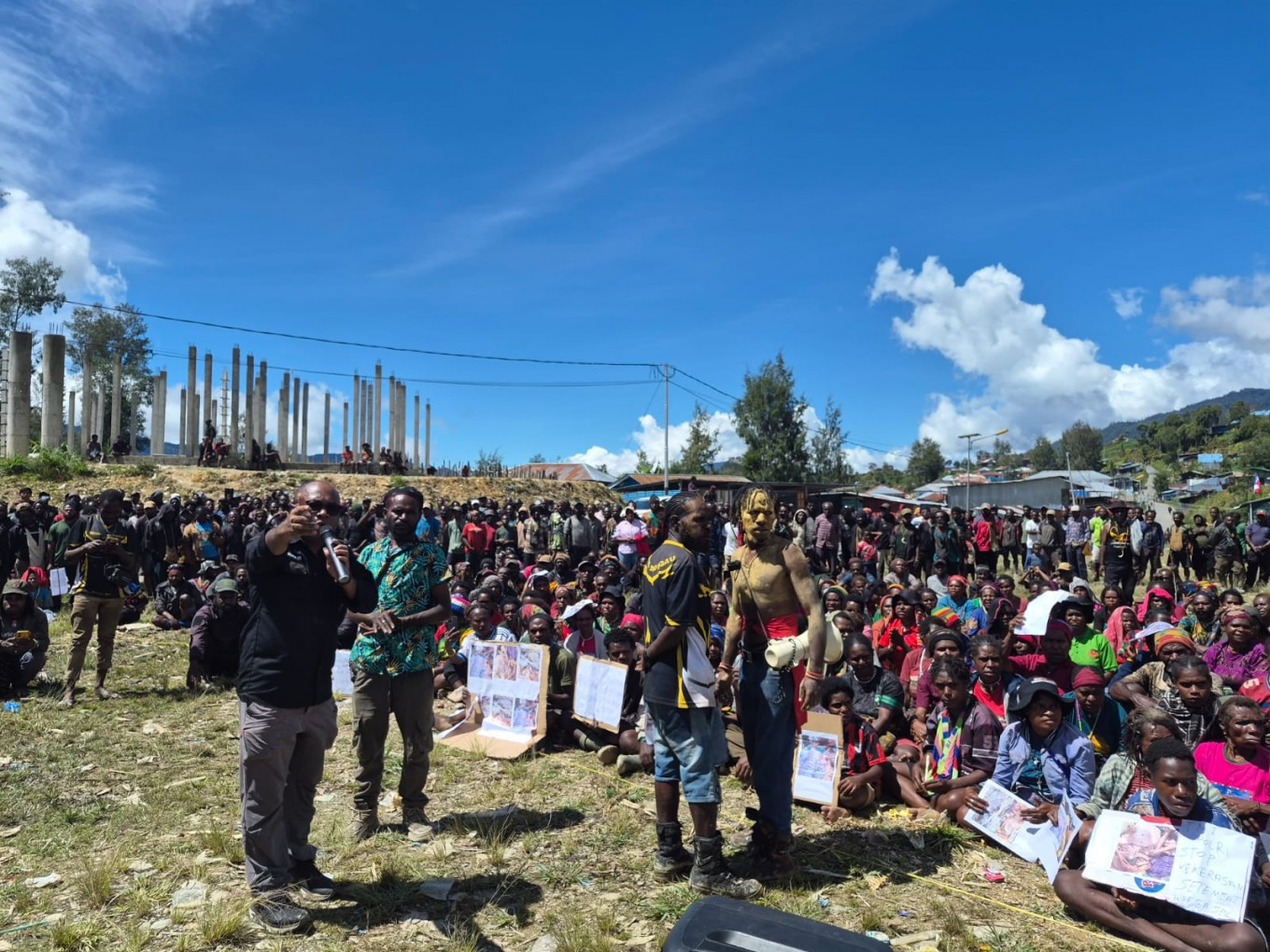
“Papuans can only demand for justice, not independence”. The statement by Human Rights Minister Natalius Pigai on Aug. 17, draws a clear constitutional boundary. Yet a constitutional boundary does not, by itself, settle a political relationship.
The boundary may be clear. Belonging is not.
In Papua, the distinction matters. Indonesia’s sovereignty over the territory is not the issue here. The more difficult question is what allows sovereignty to endure not merely as an assertion of authority, but as a political relationship in which citizens can see themselves.
John Locke confronted a related problem more than three centuries ago. In Two Treatises of Government (1689), he argued that political authority rests not simply on the capacity to rule, but on the consent of those who are governed and the protection of their rights. Authority, in other words, does not justify itself.
For Papua, this does not mean reopening the question of Indonesian sovereignty. It suggests something more demanding: sovereignty must continually demonstrate its value to those who live under it. That demonstration is rarely found in constitutional language. It is encountered in ordinary institutions, in schools and hospitals, courts and local government offices, workplaces and political forums.
A policy may look generous from Jakarta and still feel inadequate in Jayapura. The distance between policy design and lived experience is often where legitimacy begins to fray.
The Basque experience in Spain offers a useful comparison, precisely because it should not be treated as a model for Papua.
After decades of conflict, Spain did not reduce the Basque question to a choice between unity and fragmentation. Its 1979 Statute of Autonomy established the Basque Country as an autonomous community within Spain and provided a framework for self-government.
The historical circumstances are plainly different. So are the constitutional arrangements. Yet the case unsettles a familiar assumption: political unity and political distinctiveness do not necessarily have to cancel each other out.
Will Kymlicka, in Multicultural Citizenship: A Liberal Theory of Minority Rights (1995), takes this tension seriously. He distinguishes between common citizenship and forms of self-government, while pointing to a difficult paradox: denying meaningful self-government can itself deepen demands for separation. Carefully designed accommodation can therefore become part of the architecture of political unity rather than its opposite.
In Papua, that possibility deserves attention. Indonesia has already invested heavily in this premise through special autonomy, fiscal transfers, affirmative policies for indigenous Papuans and special political arrangements. The question now is less whether another layer of authority or funding should be added than whether existing arrangements are producing something more consequential: political agency.
Agency means more than receiving resources. It means having a credible voice in decisions, seeing institutions respond, being able to demand accountability and experiencing public authority as something that works rather than merely governs. The choice, then, need not be between political space and national unity. Political space may be precisely what makes unity more durable.
For Jakarta, the gain is more than administrative. Territorial integrity becomes less dependent on coercive capacity and more firmly grounded in institutional performance, inclusion and public confidence. For Papuans, the gain should be equally tangible: not another promise of inclusion, but greater capacity to shape decisions that affect their lives. This is not accommodation at the expense of sovereignty. It is an argument for making sovereignty more legitimate.
There is another reason for caution. Papua does not speak with one voice. Some Papuans seek independence; others support remaining within Indonesia; many are primarily concerned with education, employment, health, security and the prospects of their families.
The loudest political claim should not automatically be mistaken for the broadest social preference. A government that treats every grievance as separatism may overlook citizens whose relationship with the state is shaped less by ideology than by whether a school functions, a hospital serves them, a court treats them fairly or a local government listens.
The challenge is ultimately one of statecraft. The strongest states are not those that eliminate disagreement. They are those capable of absorbing disagreement without allowing political differences to harden into permanent estrangement. That requires neither weakness nor endless concession. It requires institutions capable of turning difference into participation and authority into something citizens can recognize as legitimate.
For Indonesian sovereignty in Papua, the harder test is not whether Jakarta can repeatedly assert that Papua belongs to Indonesia. That question has already been settled constitutionally.
The harder question is whether enough Papuans can say, without being instructed to say it, that Indonesia belongs to them too.
This is where sovereignty becomes legitimacy. A genuine win-win solution can begin there.
***
By Julian Aldrin Pasha.
The writer is an associate professor at University of Indonesia's Faculty of Social Sciences and Political Science (FISIP UI) and head of the Institute of Democracy and Human Rights, The Habibie Center.
This article was published in www.thejakartapost.com on Fri, August 21, 2026.